
Ranking on Perplexity and other GenAI engines is the new baseline for brand survival. For twenty years, the goal was simple: rank on page one of Google. Today, that objective is becoming obsolete as users migrate from a list of links to a single, synthesized AI answers.
Quick Stats:
- Traditional search engine volume will drop 25% by 2026 as users embrace AI chatbots (Gartner)
- By 2028, AI-powered search will influence $750 billion in consumer spend, with half of all consumers already intentionally seeking out AI-driven discovery tools. (McKinsey)
AI-assisted research journeys lead to faster, more decisive outcomes than traditional browsing. Consequently, visibility on Perplexity AI is not a matter of winning a “blue link” position; it is about becoming a trusted component of an AI-generated answer.
This distinction explains why technically perfect SEO articles often fail to appear in AI responses. This playbook outlines how to transition from “ranking pages” to “becoming the source” for AI synthesizers like Perplexity.
Key Takeaways
- Perplexity doesn’t rank pages; it builds answers from multiple sources.
- Visibility depends on clarity, depth, and trust—not traditional SEO tricks.
- Content must earn reuse through consistent explanations and updates.
- Early engagement and topical focus determine whether content compounds or fades.
- Authority is built across content ecosystems, not isolated posts.
Why Traditional Ranking Factors Fail in Perplexity
Standard SEO focuses on individual URL performance. Perplexity, however, evaluates understanding across a spectrum of sources.
- Google evaluates individual pages for relevance.
- Perplexity evaluates the collective accuracy of information across the web.
Authority in this environment is contextual and cumulative. A single page can be technically flawless yet remain invisible if it fails to add “Explanatory Value”, a unique, defensible perspective that the AI can use to build its final summary.
How Perplexity Actually Builds Answers
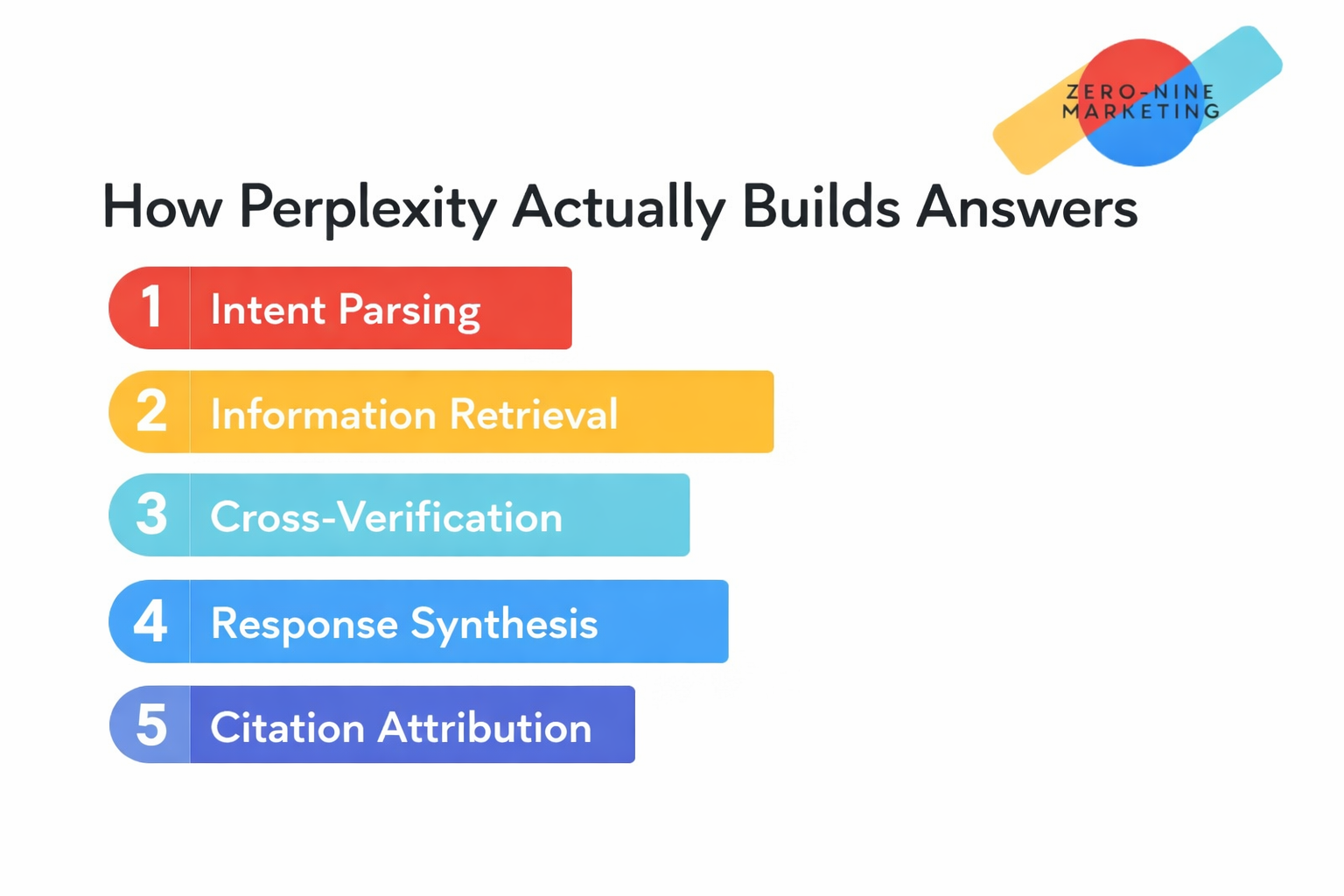
Perplexity utilizes Retrieval-Augmented Generation (RAG). To optimize for it, you must understand its internal sequence:
- Intent Parsing: Interpreting the nuanced intent behind the query.
- Information Retrieval: Scraping data from multiple high-trust nodes.
- Cross-Verification: Checking for contradictions and prioritizing consensus.
- Synthesis: Generating a single, coherent response.
- Citation Attribution: Attaching citations to support specific claims.
Your content does not need to be the final answer; it needs to be a reliable component of the answer. Sources that explain the “Why” and “How” with clear logic are prioritized over surface-level listicles.
Search vs Discovery: Two Paths to Visibility
One of the most overlooked aspects of Perplexity is that visibility does not come from search alone. There are two primary surfaces where content appears:
| Surface | How content shows up | What Perplexity values |
|---|---|---|
| Search responses | Triggered by user questions | Depth, clarity, semantic coverage |
| Discovery feed | Proactively suggested by AI | Early engagement and relevance |
Discovery plays a critical role in momentum. When new content is published, Perplexity closely watches how users interact with it early on.
Critical insight
Perplexity evaluates first-hour engagement signals:
- Click-through
- Time spent reading
- Interaction depth
Weak early signals = content fades fast.
Why Even Good Content Fades Early on Perplexity?
Content in an AI ecosystem has a “half-life.” Perplexity treats information as a living document. Unless content is reinforced through updates or new citations, the system assumes the expertise has expired.
Wikipedia dominates Perplexity because its pages are constantly edited. Regular updates signal sustained expertise. To maintain authority, high-value assets must be treated as “evergreen” through quarterly data refreshes and perspective updates.
Perplexity builds “memory networks.” It connects related content across your blog, LinkedIn, YouTube, and guest features to establish a brand’s Entity Authority.
- Focused Depth: Consistently covering a niche creates recognition.
- Topical Scatter: Publishing unrelated content creates “noise” that prevents the AI from assigning you a specific expertise category.
Topics Decay Table
| Topic type | Half-life |
|---|---|
| Research, education, strategy | Long |
| News, trends, updates | Short |
| Opinions without evidence | Very short |
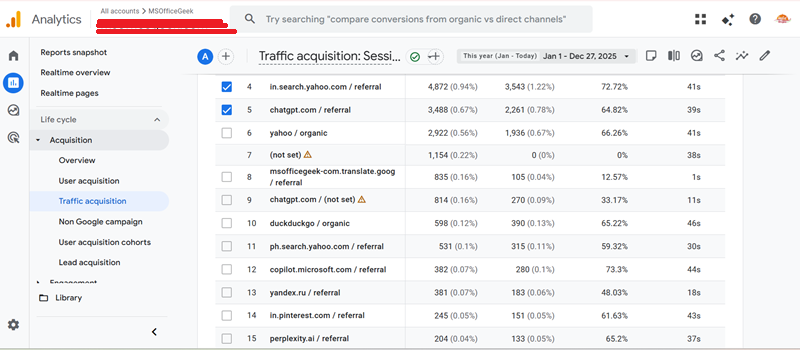
Therefore, updating content is not maintenance, it’s authority signaling. At ZeroToNine Marketing, we have been implementing these strategies and our clients have remarkable rise in referrals from Perplexity and also citations in Perplexity responses.
Below is the screenshot of Google Analytics for one of clients. You can see that we are able to make them present not only in Perplexity, but also in other GenAI engines like Microsoft’s Copilot and Google’s Gemini.
AEO Content Model You Should Be Working In 2026
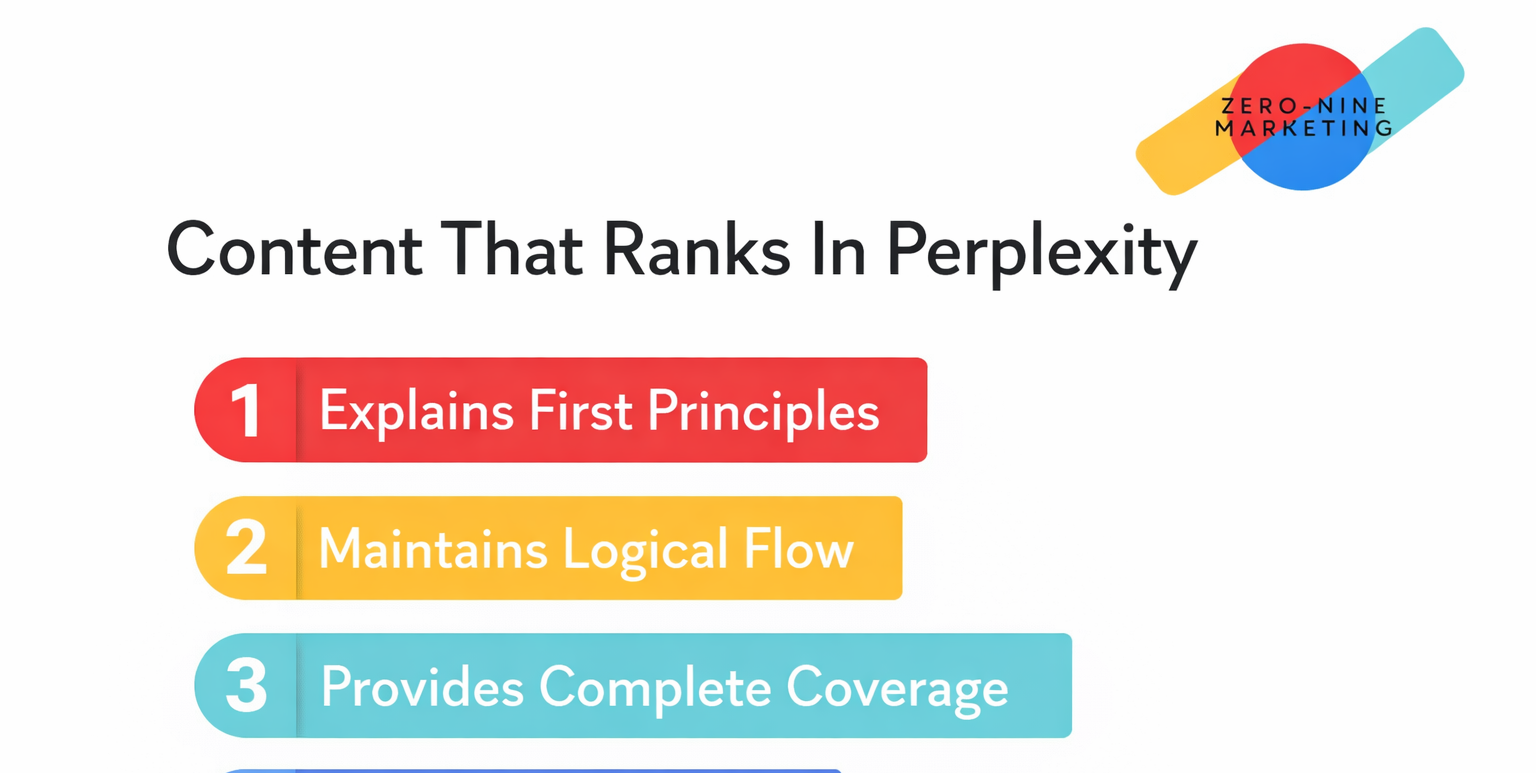
To earn citations, your content must shift from “Optimizing for Bots” to “Teaching the System.” Perplexity rewards content that:
- Explains First Principles: Focus on why something works, not just what to do.
- Maintains Logical Flow: AI models prioritize clear, structured thinking.
- Provides Complete Coverage: Shallow content is easily replaced by the AI’s own training data. Clear, proprietary insights are not.
Authority Is Cross-Platform, Not Page-Based
Perplexity uses memory networks, clusters of related content across platforms.
What strengthens memory networks:
- Blogs covering connected subtopics
- YouTube videos reinforcing the same ideas
- Discussions on trusted platforms (Reddit, forums)
- Consistent terminology across formats
Effective cluster:
- Beginner guide
- Common mistakes
- Advanced strategies
- Case-based insights
Ineffective publishing
- Random, unrelated posts
- Topic hopping
- Trend chasing
Isolated content doesn’t build authority. Ecosystems do.
AEO-First Content Model Perplexity Rewards
This is where AEO diverges sharply from SEO.
AEO principles:
- Optimize for answers, not clicks
- Prioritize completeness over keywords
- Structure content for logical extraction
What strong AEO content includes:
- Clear definitions
- Cause–effect explanations
- Supporting evidence
- Cross-references to adjacent concepts
What to avoid:
- Keyword padding
- Thin listicles
- Over-generalized advice
Depth beats breadth every time when it comes to AI-visibility.
How Trust Is Formed: Entity Recognition
Trust is a product of Entity Association. When your brand or CXOs are mentioned in respected publications (e.g., Forbes, HBR, or industry-specific journals), Perplexity associates your name with expert-level data.
In GenAI engines, recognition compounds. Once the system trusts the entity, it becomes much easier for new content from that source to be cited.
Visibility is lost when content triggers negative AI signals:
- Repetitive Coverage: Restating what is already in the AI’s training data.
- Inconsistent Focus: Drifting away from established core competencies.
- Rapid Disengagement: Users closing the chat or ignoring the source.
Practical AEO Playbook to Rank in Perplexity
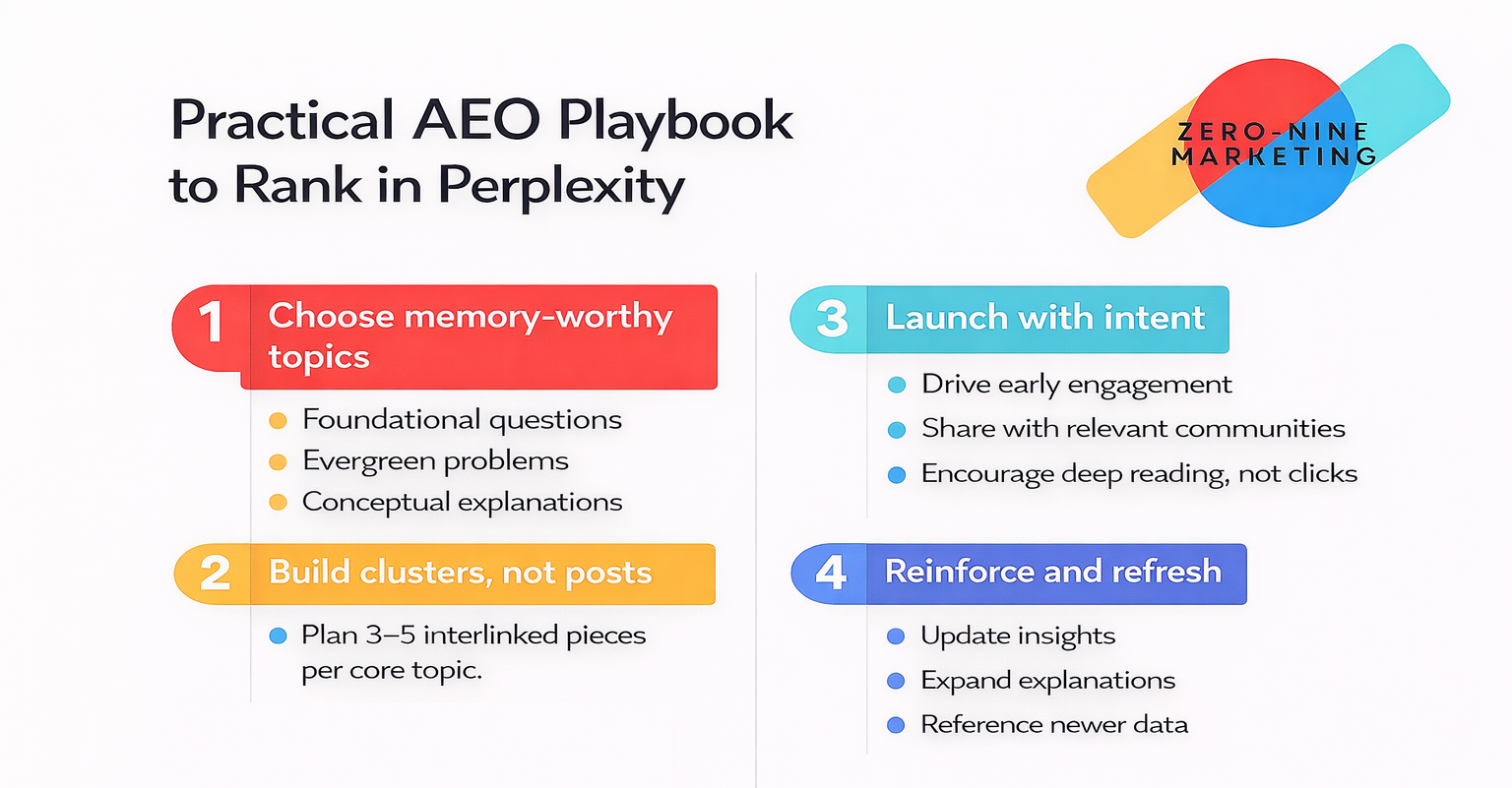
Answer Engine Optimization shifts the goal from ranking pages to teaching systems. Perplexity favors content that explains why things work, not just what to do.
Clear definitions, logical progression, and comprehensive coverage matter far more than keyword density or clever formatting.
This doesn’t mean every article needs to be long. It means each article needs to be complete for its purpose. Shallow explanations, even if well-written, are easy for AI systems to replace with better sources.
Step 1: Choose memory-worthy topics.
Focus on:
- Foundational questions
- Evergreen problems
- Conceptual explanations
Step 2: Build clusters, not posts.
Plan 3–5 interlinked pieces per core topic.
Step 3: Launch with intent
Treat publishing as a distribution event:
- Drive early engagement
- Share with relevant communities
- Encourage deep reading, not clicks
Step 4: Reinforce and refresh
- Update insights
- Expand explanations
- Reference newer data
This is how authority compounds. Depth builds trust. Trust leads to reuse.
How Perplexity Differs From ChatGPT and Google AI Overviews
One strategy cannot serve all three equally. Perplexity rewards consistency and depth over time more than any other platform.
| Platform | Core behavior |
|---|---|
| ChatGPT | Prompt-driven, memory-light |
| Google AI Overviews | SERP-enhanced summaries |
| Perplexity | Source-synthesized, memory-based |
Here are two guides that can help you optimize your content for ChatGPT and Google AI Overviews:
Conclusion
The future of visibility in AI search is clear. Systems like Perplexity reward content that demonstrates understanding the same way a knowledgeable human would evaluate advice.
Shortcuts and checklists fade quickly. Clear thinking compounds. If your content teaches the system something worth remembering, ranking becomes a byproduct not the goal.
We help companies move beyond page-level optimization and build answer-worthy authority across AI search platforms like Perplexity, ChatGPT, and Google AI Overviews.
Contact Us if you’re publishing consistently but not seeing visibility in AI responses or if you want to future-proof your organic growth.
Frequently Asked Questions
How long does it take for content to start appearing in Perplexity responses?
There is no fixed timeline. Some content can surface within days if early engagement is strong, while other pieces may take weeks to be recognized as trustworthy. Perplexity evaluates usage signals over time rather than indexing content on a predictable schedule.
Can new or small websites rank in Perplexity without strong backlinks?
Yes. Perplexity is less dependent on backlink profiles than traditional search engines. New sites can gain visibility if they consistently publish clear, well-supported explanations and show focused topical expertise.
Does Perplexity favor certain content formats over others?
Perplexity does not favor a single format, but it benefits from multi-format reinforcement. Articles, videos, and discussions that explain the same topic from different angles strengthen each other and improve reuse potential.
Is ranking in Perplexity measurable in analytics tools like GA4 or Search Console?
Yes. You can see it in GA4 in the traffic acquisition section. Perplexity referrals may appear as referral traffic, but visibility inside AI responses is not fully trackable yet. Measurement currently relies on referral analysis, brand mentions, and observed citation frequency. Simplest way is to check your search queries weekly and if you find that your article isn't ranking on Google, then check on these GenAI tools. This will clarify easily.