
Google doesn’t just list search results; it answers questions for users in a clear, concise, AI‑generated overview. Google SGE in Australia, also known as AI Overview, has been recently rolled out and is changing how people find information online, and it’s not limited to Google alone.
Optimising for SGE also boosts visibility on other generative search engines like ChatGPT, Perplexity, Grok, and Claude. For Australian businesses, mastering this shift could be the difference between being seen and being overlooked.
Quick Stats:
- Google currently controls nearly 94 % of Australia’s search market.
- Meanwhile, Australian businesses are expected to spend AUD 1.5 billion on SEO in 2025, a 12 % increase from 2024.
These numbers clearly show that search is not just evolving, but transforming entirely.
In this article, let’s explore what Google’s Search Generative Experience (SGE) and AI Overviews mean for Australian businesses, how they work, and why adapting now will be key to staying competitive.
Let’s begin by breaking down what SGE really is and how it’s rolling out in Australia.
TL;DR – Key Takeaways
- Google SGE (Search Generative Experience) delivers AI-powered summaries, called AI Overviews, directly on the search results page.
- Optimising for SGE improves visibility on Google and other generative engines like ChatGPT, Perplexity, Grok, and Claude.
- Key ranking factors include E‑E‑A‑T (Experience, Expertise, Authoritativeness, Trustworthiness), structured data/schema markup, conversational keyword alignment, content clarity, and freshness.
- Common pitfalls to avoid: ignoring zero‑click search impacts, over‑optimising keywords, neglecting local SEO, poor schema implementation, and outdated content.
- Future of SGE: more conversational search, stronger localisation, and integration across platforms — making early adaptation essential.
Begin adapting your SEO strategy now to secure visibility in the AI‑driven search future.
What Is Google SGE / AI Overviews?
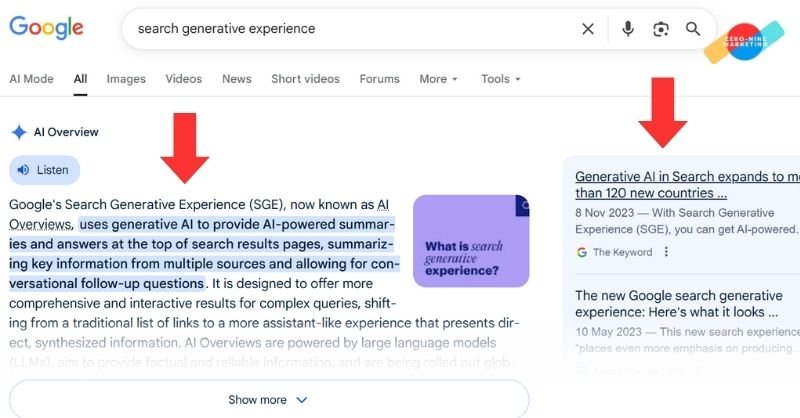
Google’s Search Generative Experience (SGE) is more than just an upgrade to traditional search. It’s a rethinking of how answers are presented.
Instead of a simple list of links, SGE uses artificial intelligence to provide a concise, context‑rich summary of the topic you’re searching for. These summaries are called AI Overviews.
Think of AI Overviews as an intelligent briefing: they collate information from multiple sources, summarise it in natural language, and present it alongside citations so users can explore deeper. For Australian businesses, this changes both how and where your content appears in search results.
Key aspects of Google SGE and AI Overviews include:
- Conversational search results – Answers are framed in a way that reads like a human explanation rather than a list of links.
- Source attribution – AI Overviews cite websites, allowing for visibility even without direct clicks.
- Context awareness – SGE uses a user’s search history, location, and query intent to deliver personalised responses.
- Zero-click search impact – Many queries may not lead to a click, with answers visible directly on the results page.
In Australia, SGE is now live and being integrated across Google Search and Maps, with businesses already seeing shifts in traffic and search behaviour. This isn’t a future trend — it’s happening now.
With that in mind, the next question is why Google SGE matters so deeply for Australian businesses and how it could change your entire SEO strategy.
Why SGE / AI Overviews Matter for Australian Businesses
Google SGE is a paradigm shift for how Australian businesses compete for attention online. The change is not just about ranking in the traditional sense; it’s about being the source that Google trusts enough to feature in its AI Overviews.
Here’s why this matters:
- Changing click behaviour: Studies show that over 50% of search queries now result in zero clicks, as answers are displayed directly on the search page. This means traditional ranking positions no longer guarantee traffic. Being featured in an AI Overview becomes critical for visibility.
- Enhanced brand authority: AI Overviews cite credible sources. If your business is selected, it signals trustworthiness to users, which strengthens your brand reputation even without a click.
- Local relevance: Australian consumers increasingly rely on hyper‑local search results. SGE leverages location and context, making local optimisation essential. Businesses that fail to adapt risk losing presence in local discovery.
- Cross‑platform impact: Optimising for Google SGE has benefits beyond Google Search. It also increases visibility on generative AI engines like ChatGPT, Perplexity, Grok, and Claude, expanding reach across multiple discovery platforms.
In short, Google SGE changes the rules of SEO. For Australian businesses, adapting to it is not optional; it’s vital for maintaining competitive advantage.
Understanding why SGE matters naturally leads to a deeper question: What exactly influences rankings within this new generative search environment?
Key Ranking Factors in the SGE Era
Google’s Search Generative Experience changes how content is discovered and ranked. Traditional ranking signals like backlinks and keywords remain important, but SGE introduces additional factors that directly influence whether your content gets selected for AI Overviews.
For Australian businesses, understanding these factors is essential to ensure your content isn’t just indexed, but also featured prominently.
Here are the key ranking factors in the SGE era:
- E‑E‑A‑T (Experience, Expertise, Authoritativeness, Trustworthiness): Google’s AI relies heavily on credible sources. Websites that demonstrate genuine expertise in their field — with author credentials, citations, and relevant content depth — are more likely to be included in AI Overviews.
- Structured data and schema markup: Schema helps Google understand your content in detail. FAQ, How-To, Local Business, and Article schemas are particularly effective in signalling relevance for generative search results.
- Content structure and clarity: AI prioritises content that is easy to read and logically organised. Use clear headings, short paragraphs, bullet points, and concise summaries to make your content AI‑friendly.
- Conversational query alignment: SGE is designed to respond to natural language queries. Content optimised for conversational phrasing — including long-tail keywords, question-based headings, and localised language — has higher chances of selection.
- Content freshness: AI Overviews favour up-to-date information. Regularly revisiting and refreshing content ensures your pages remain relevant.
- Technical performance: Mobile-first design, fast page speed, crawlability, and secure HTTPS connections all impact your eligibility for inclusion in AI Overviews.
These factors collectively redefine what it takes to rank in Google’s generative search ecosystem. Businesses that prioritise them will stand out in a competitive landscape.
Next, we’ll translate these ranking factors into an actionable framework.
Also Read: How Our SEO Strategy Scaled MSOfficeGeek.com Without Ads
Step-by-Step: How to Optimise Content for SGE / AI Overviews
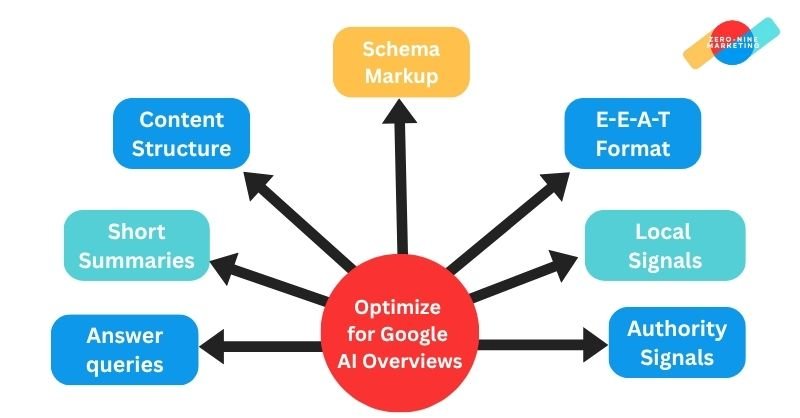
Optimising for Google’s Search Generative Experience isn’t guesswork. It requires a deliberate, structured approach that aligns with how generative AI interprets and presents information. For Australian businesses, this means tailoring content to be both AI‑friendly and highly relevant to your audience.
Here’s a practical optimisation roadmap:
Target the right queries: conversational + intent first
- Pick question-style queries (who, how, why, best, compare). AI Overviews favour concise answers to explicit questions.
- Localise: include city/suburb phrasing and local qualifiers (e.g., “in Melbourne”, “near Bondi”, “certified in NSW”).
- Map intent: classify queries as informational, transactional, or local-intent; AI Overviews most often appear for high-value informational queries (how-to, comparison, best-of).
- Tools: use People Also Ask, AnswerThePublic, your site search logs, and ChatGPT/Perplexity to generate realistic conversational queries. Industry practitioners also recommend using generative tools to surface unexpected phrasing.
What you need to do: Create a list of 10–25 conversational queries per target page. Mark, which are localised, which are product/service specific, which are comparative.
Lead with a tight summary that answers the question
AI systems prefer concise, unambiguous answers to extract into summaries.
- How: Start your section (or the page) with a 1–3 sentence answer that directly responds to the query — think of this as your “AI summary” that a machine can lift verbatim.
- Formatting tip: Place the short answer in a standalone paragraph under an H2 using the question form (e.g., H2: How long does solar panel installation take in Melbourne? – immediate 1–2 sentence answer).
Example:
- H2: What does Google SGE mean for small businesses?
- Lead: Google SGE provides AI-generated summaries that answer user questions directly on the search results page, so businesses must surface clear, authoritative content to be cited.
Structure Content for AI Readability
- Headings matter: Use H2s and H3s that mirror real questions. Machines match heading text to queries.
- Chunk content: Short paragraphs, numbered steps, bullet lists, and tables are easier to parse and more likely to be quoted.
- Highlight key facts: Use bold sparingly for crucial items (e.g., timeframes, costs) so the AI can find succinct data points.
What you need to do: Ensure that each H2 answers one user query. Use bullets or numbered steps for processes. Include a one-line summary before long sections.
Implement Schema Markup Strategically
Structured data helps Google understand page elements and makes your content eligible for specific rich features (FAQ, HowTo, LocalBusiness). Google recommends and documents FAQPage and QAPage schemas for Q&A content.
What to do:
- Add FAQPage schema for explicit Q&A blocks.
- Add HowTo schema for procedural content.
- Add LocalBusiness schema for location pages.
- Use JSON-LD and test in Google’s Rich Results / Schema validator.
Demonstrate E-E-A-T (Experience, Expertise, Authoritativeness, Trust)
What E-E-A-T looks like: author bylines with relevant credentials, cited sources, case studies, original data, and transparent sourcing. Google’s guidance emphasises helpful, reliable, people-first content. Google for Developers
Practical steps:
- Add author bios and link to author profiles.
- Publish original data or localised case studies.
- Cite official sources and industry bodies.
- Use review/testimonial snippets where appropriate (and mark them up with schema).
Use Multimedia Strategically
AI Overviews and SERP panels often surface images and videos alongside summaries; multimedia helps your content stand out and provides additional extractable signals.
How:
- Use descriptive file names and alt text.
- Include transcripts for videos.
- Add captions or short image captions that restate key facts
Local Signals: Google Business Profile, reviews, citations
SGE uses context; local business signals reinforce location relevance for Australian queries.
How:
- Fully optimise Google Business Profile (categories, services, accurate hours).
- Encourage and manage reviews — respond and cite them on your site where relevant.
- Ensure NAP consistency across directories.
Freshness, Versioning, and Monitoring
Revisit pages every 3–6 months for factual accuracy and new signals. AI Overviews favor up-to-date content.
Monitoring:
- Track impressions and CTR in Google Search Console.
- Monitor zero-click trends and query performance as zero-click searches are rising, so track loss/gain in clicks vs impressions.
- Use rank-tracking for target Q&A queries and track appearance in People Also Ask / AI Overview-like SERP features.
Outreach for Citations and Authority Signals
Get your content cited by other reputable sites and local publications — AI Overviews often reference authoritative sources.
Tactics:
- Publish data-led studies or surveys that others will link to.
- Pitch local news, industry bodies, and niche blogs.
- Share structured data and one-line summaries to make quoting easier.
Optimising for AI Overviews is a repeatable process: pick priority pages, give machines a clean extractable answer, prove expertise, and keep the content fresh.
These steps improve your chances of being featured in Google SGE and also in Generative Engine Optimization, making your content more usable by other generative engines and chat assistants, which broadens where people can discover and trust your brand.
With optimisation strategies in place, it’s valuable to look at real‑world examples of how SGE is already affecting Australian search results. That’s what we’ll examine in the next section.
Real-World Examples: SGE in Action for Australian Businesses
We recently conducted research analysing how Australian businesses are adapting to Google’s Search Generative Experience.
What we found makes it clear: those who optimise early are not just maintaining visibility, they are leading in their industries. These case studies illustrate the real-world impact of SGE and why Australian businesses must act now.
Example 1: Local Search Queries
Our research found a café in Bondi that had implemented clear headings, localised keywords (“best café in Bondi”), structured data, and concise summaries.
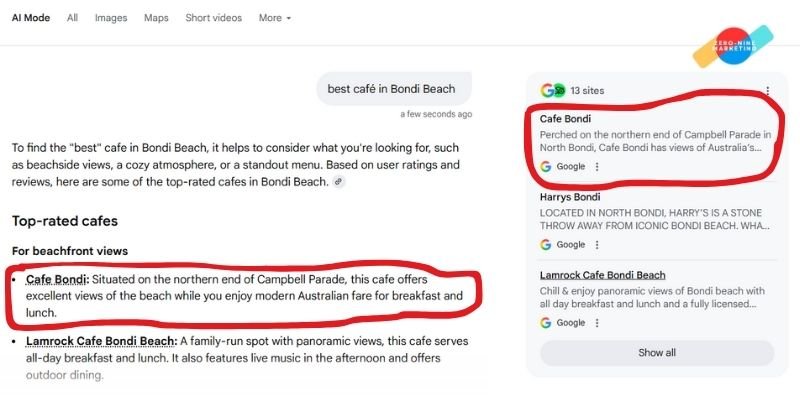
This café began appearing in AI Overviews for relevant queries, not just in the top ten organic listings. Their menu, location, and reviews now appear directly within AI summaries — dramatically increasing brand exposure.
Example 2: Service-Based Businesses
We identified a Melbourne-based solar installation company that invested in optimised long-form content with a “How-To” structure, FAQ schema, and localised language.
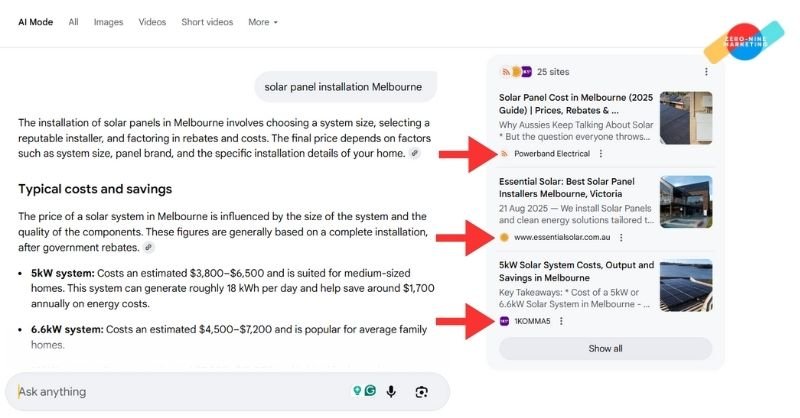
As a result, when users searched “solar panel installation Melbourne,” Google’s SGE featured their content directly in the AI Overview, citing the company as a trusted source. This led to improved click-through rates and a stronger authority position in their niche.
Example 3: Content Credibility and Trust
Our review also included a Sydney legal services firm that regularly published expert articles with citations, author bios, and updated case studies.
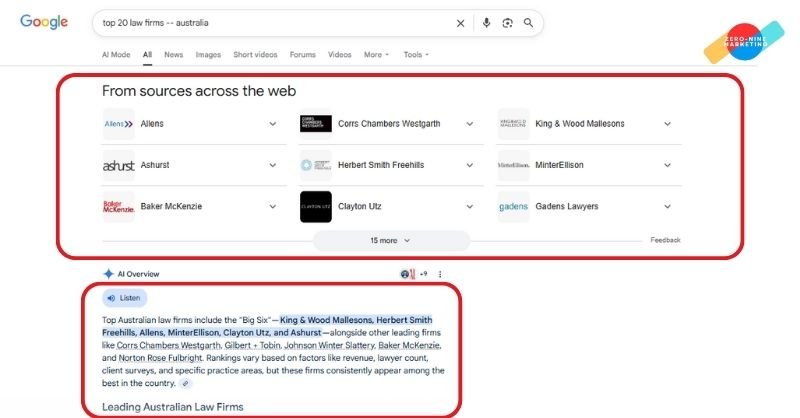
This consistent approach resulted in increased brand citations through AI Overviews. Even without a click, the firm’s name was consistently associated with credibility and authority.
These examples prove one thing: optimising for SGE is not theoretical — it delivers measurable results. It’s about providing clear, structured, and trustworthy content that AI trusts to feature.
At Zero To Nine Marketing, we don’t just talk about SGE optimisation — we make it happen. Our team works with Australian businesses to develop AI‑friendly SEO strategies that position them for prominence in Google SGE and other generative search engines like ChatGPT, Perplexity, Grok, and Claude.
Understanding how SGE impacts Australian businesses naturally leads to recognising the risks of ignoring it. The next section will explore the common pitfalls and challenges businesses face when adapting to generative search and how to avoid them.
For our case studies, check out: How to Rank in Google AI Overviews with Real Client Results
Pitfalls to Avoid While Optimizing Your Content for Google AI Overviews
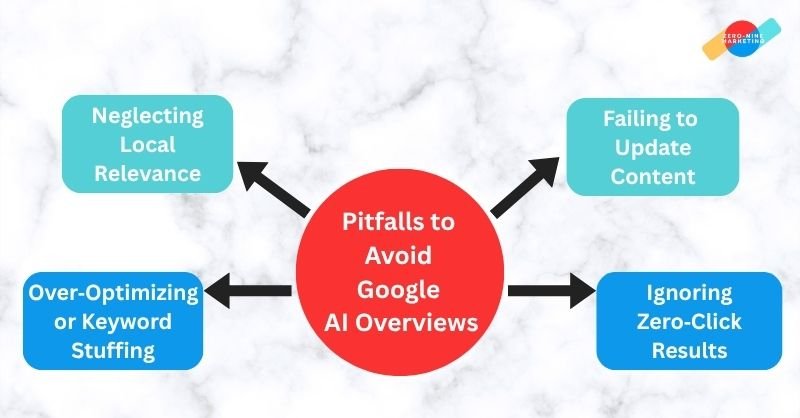
While Google’s Search Generative Experience opens new opportunities, it also raises the bar for SEO. Many Australian businesses risk losing visibility simply because they don’t adapt their approach fast enough. Understanding these pitfalls ensures your strategy remains proactive.
Ignoring the Impact of Zero‑Click Results
One of the biggest shifts SGE introduces is the rise of zero-click searches, where users get their answers directly on the results page without visiting a website. This means even high-ranking pages may see declining traffic if they aren’t optimised for featured placement in AI Overviews.
Businesses need to focus less on just ranking and more on being referenced. That means structuring answers clearly, using schema markup, and ensuring your content provides concise, fact-based responses that Google can confidently cite.
Over‑Optimising or Keyword Stuffing
Old-school SEO habits can backfire under SGE. Overusing keywords, adding repetitive phrases, or forcing target terms into unnatural sentences signals low-quality writing to Google’s AI.
Instead, focus on contextual optimisation, use semantically related terms, answer questions naturally, and write like a human expert, not a keyword robot. Google’s AI systems are designed to reward clarity and user satisfaction, not density or repetition.
If Google feels your content was written to trick the algorithm, SGE won’t feature it.
Neglecting Local Relevance
Generative search thrives on context, and local context is one of its strongest signals. When users search for “best accountant near Parramatta” or “eco-friendly café in Perth,” SGE will prioritise results that combine authority with proximity.
Australian businesses that skip local SEO essentials, such as optimising Google Business Profiles, including location-based keywords, embedding maps, and adding LocalBusiness schema, risk losing visibility to nearby competitors who have done so.
If your business serves a defined region, make sure Google’s AI knows where you are and who you serve.
Failing to Update Content
SGE prioritises fresh, relevant, and actively maintained content. Pages that haven’t been updated in over six months are unlikely to be pulled into AI Overviews. Regularly revisiting content shows Google your site is trustworthy and alive.
Moreover, these updates don’t need to be drastic. Even small revisions, refreshed data, and new internal links can signal relevance. Treat every high-value page as a living asset. Add timelines for review, include current examples, and update any stats or product details as the market evolves.
Understanding these pitfalls naturally leads to considering what the future holds. The next section will explore the evolving role of SGE in Australia and what businesses must do to remain competitive in the years ahead.
Future of Google Search Generative Experience in Australia
Google’s Search Generative Experience is still evolving, but one thing is clear that generative search is not a passing trend. For Australian businesses, understanding their trajectory is critical to staying competitive in the coming years.
The future of SGE will likely be shaped by three major developments.
Increasing Conversational Search Integration
Search will become more conversational, with AI delivering nuanced answers tailored to user context. Businesses will need to adapt by creating content that answers queries in a natural, dialogue-friendly style rather than traditional keyword-heavy formats.
Greater Localisation of Search Results
SGE will increasingly incorporate local context, drawing from regional data, reviews, and location-specific content. For Australian businesses, this means investing in hyper-local SEO strategies that include local keywords, schema markup, and Google Business Profile optimisation.
Integration Across Platforms
SGE won’t remain confined to Google Search. Generative AI responses will extend into Google Maps, Google Lens, and other Google tools, as well as generative platforms like ChatGPT, Perplexity, Grok, and Claude. Businesses optimised for SGE will naturally benefit from broader visibility.
Businesses that embrace these changes will gain a significant edge. This isn’t about reacting to an algorithm; it’s about preparing for a fundamental change in how information is discovered and consumed.
Clearly, Australian businesses that want to lead in the SGE era must start adapting now. This brings us to a critical summary of what we’ve covered and why action matters. The next section will conclude our discussion with final insights and a clear call to action.
Conclusion
Google’s Search Generative Experience is reshaping search in Australia. Businesses that understand and adapt to this shift will not only maintain visibility but also gain a competitive edge.
Therefore, waiting for SGE to become fully mainstream will mean lost opportunities and diminished brand presence. Strategic preparation today will ensure you stay ahead of competitors tomorrow.
With the future of search becoming increasingly AI-driven, a clear understanding of how to optimize for SGE is essential.
At Zero To Nine Marketing, we are committed to helping Australian businesses navigate this shift. From generative search audits to AI‑optimised SEO strategies, we offer tailored solutions that position your business for long-term visibility and growth.
Don’t let your competitors get ahead.
Book a strategy consultation with us today and future-proof your visibility in Australia’s AI-powered search era.
Frequently Asked Questions
How does SGE impact small businesses?
Small businesses face both opportunity and risk. Those who adapt early and optimize for SGE can gain visibility and brand credibility, while those who ignore it risk losing clicks and discoverability. Local optimization is especially critical for SMEs in Australia.
Will SGE replace traditional SEO?
No. SGE adds a new layer to SEO, not a replacement. Traditional ranking factors like relevance, backlinks, and technical SEO still matter, but they must be combined with generative‑friendly strategies to succeed in the SGE era.
How can I get my content featured in AI Overviews?
Focus on producing authoritative, structured, and conversational content. Use schema markup, address user questions directly, incorporate local context, and regularly update content. This combination increases the chances of being selected for AI Overviews.
What is Generative Engine Optimization (GEO)?
GEO is the process of optimizing content specifically for generative search engines like Google SGE, ChatGPT, Perplexity, Grok, and Claude. It involves tailoring content to be clear, structured, and contextually relevant for AI-driven search responses.